Finding the right printing paper for wedding invitations ensures your invites look polished and professional. This guide highlights fivedelta, printer-friendly options suited to different budgets and design goals. Whether you want handmade texture, classic borders, or crisp white cardstock, there’s a fit for your wedding theme and printer setup. The top picks cover handmade deckled edges, border-ready finishes, linen textures, and high-quality standard cardstocks—each with clear suitability notes to help you decide.
Summary of selected products
| Product | Best For | Key Benefit | Limitations |
|---|---|---|---|
| 50 Sheets Deckled Edge Paper 5 x 7 inch (Prudiut) | Vintage or handmade-style invitations | Deckled edge, textured watercolor feel | May require thicker printers or manual feeding |
| Gartner Studios Border Wedding Invitation Kit | Complete, ready-to-print invitations | Pearl white stock with border, envelopes included | Pre-designed layout limits deep customization |
| Linen Textured Cardstock White (COLOANDUS) | Professional-looking DIY invitations | Linen finish, thick coverage | Printer settings may need adjustment for heavy stock |
| White Cardstock 8.5 x 11 (Manilaus) | General invitations, menus, cards | Premium 80 lb/235 gsm white stock, printer-ready | Best for standard printer formats; avoid very small text |
Deckled Edge Handmade Paper For Invitations

Product: 50 Sheets Deckled Edge Paper, 5 x 7 inches, 160 GSM. This handmade, cold-pressed watercolor-style paper features a traditional deckled edge and a rough texture, ideal for vintage or artsy wedding invitations. It pairs well with calligraphy and watercolor-inspired designs. Best for couples seeking a handmade look and tactile feel. Limitations include potential compatibility issues with very light ink coverage on textured surfaces and the need for careful feeding in some home printers.
Gartner Studios Border Wedding Invitation Kit
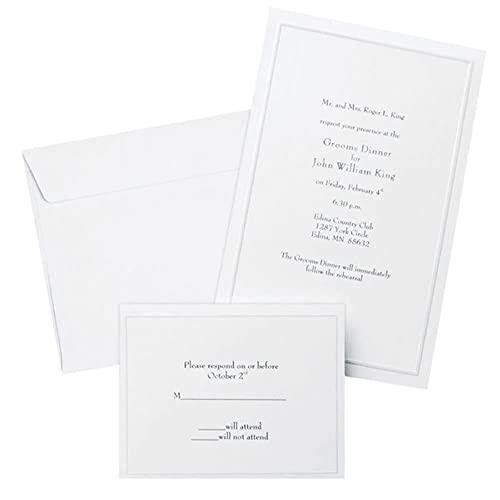
Product: Border Wedding Invitation Kit, Pearl White, 50-Count. Features smooth white cover stock invitations with a delicate pearl foil border, plus envelopes and matching response cards. Invitations measure 5.5” x 8.5”; response cards are 4.25” x 5.5”. Best for couples who want a classic, ready-to-print design with simple assembly. Choose this if you want a cohesive set with envelopes; avoid if you require non-traditional borders or alternate sizes.
Linen Textured Cardstock White (COLOANDUS)

Product: Linen Textured Cardstock White, 100 Sheets, 8.5 x 11 Inches. Thick, linen-finish stock designed for printers and crafts. Each sheet is about 0.26 mm thick (80 lb cover / 146 lb text / 216 gsm). Best for invitations and DIY cards requiring a premium look with a subtle texture. Choose this for high-quality printing with a tactile feel; limit is printer compatibility with heavier cardstock and potential feed issues on some home printers.
White Cardstock 8.5 x 11 Inch (Manilaus)

Product: White Cardstock, 8.5 x 11, 80 lb (235 gsm). This premium heavyweight stock offers a bright, smooth surface suitable for sharp letterpress-like prints and detailed graphics. Best for modern, clean wedding invitations and inserts. Choose this if you want crisp typography and reliable printer feeding; avoid if your design requires a textured or specialized surface that hides imperfections.
Buying Guide
What should you consider when selecting wedding invitation printing paper?
- Print method: Inkjet versus laser compatibility can influence weight tolerance and surface texture.
- Texture and finish: Deckled edges and linen textures add character, but may impact legibility for small fonts or fine details.
- Weight and thickness: Heavier stocks look premium but may require specialized printers or manual feeding.
- Size and layout: Ensure paper size matches your invitation templates; some kits include pre-cut sizes for easy assembly.
- Budget and scalability: Bulk packs are cost-effective for large guest lists; consider mixing stock for RSVP cards or inserts.
How to choose by wedding style
For vintage or handmade aesthetics, the deckled edge paper offers texture and a tactile feel that complements calligraphy. For classic weddings, a border kit with pearl foil borders pairs well with traditional typography. If your design is modern and minimalist, a bright white, smooth stock provides high contrast and clean lines. For light, watercolor-inspired designs, textured watercolor paper can enhance color depth and depth without bleeding.
Printer setup tips
- Test print on a scrap sheet before running your final invitations.
- Use the correct paper length and feed orientation to avoid jams.
- Adjust printer settings to “heavy cardstock” or “cardstock” to improve accuracy and reduce smudging.
Inspiration and layout ideas
- Pair deckled edge papers with hand-drawn script fonts for a rustic-chic invitation suite.
- Combine pearl-bordered invitations with metallic ink accents for a formal wedding.
- Use linen-textured stock for RSVP cards to maintain consistency with the main invitation.
FAQ
- What paper weight is best for wedding invitations? A: 80 lb to 100 lb text or 80 lb cover is common; heavier stocks feel premium but may require printers configured for thick media.
- Can I print invitations at home? A: Yes, with suitable cardstock and printer settings; test prints are recommended.
- Should I mix paper textures? A: Mixing textures can create contrast and hierarchy (invitation vs. RSVP card) but keep a cohesive color palette.
- Are border kits easier for first-time printers? A: Yes, they simplify layout alignment and include envelopes and response cards for a complete look.
- Do deckled-edge papers work with all printers? A: They work with many inkjet printers, but their texture can affect ink uptake; consider pigment inks for better permanence.